
Three human skills AI can’t replace, according to a UBC Sauder instructor

Lead Product Management Instructor at UBC Sauder Professional Growth, Timothy Yeung, on what it means to be irreplaceable in an AI-shaped workplace.
The most pressing question in business education today may not be the one everyone is asking. Instead of focusing on whether AI will take your job, Yeung recommends taking a step back to look at the bigger picture.
"The better question is," Yeung says, "as AI becomes more capable, more accessible, and more embedded in everyday work, what becomes even more valuable about being human?"
In his view, AI makes certain human capabilities more important, not less.
"As AI takes on more of the production or execution work, the human role shifts even more toward direction, judgement, critical thinking, creativity, meaning, trust, and responsibility,” he explains.
Yeung believes that the professionals who thrive in this environment will not simply be those who know the most tools, as tools will keep changing. The real advantage will come from combining AI fluency with something harder to automate.
UBC Sauder Professional Growth | Deeper Dive on The Biggest Myths About AI with Timothy Yeung
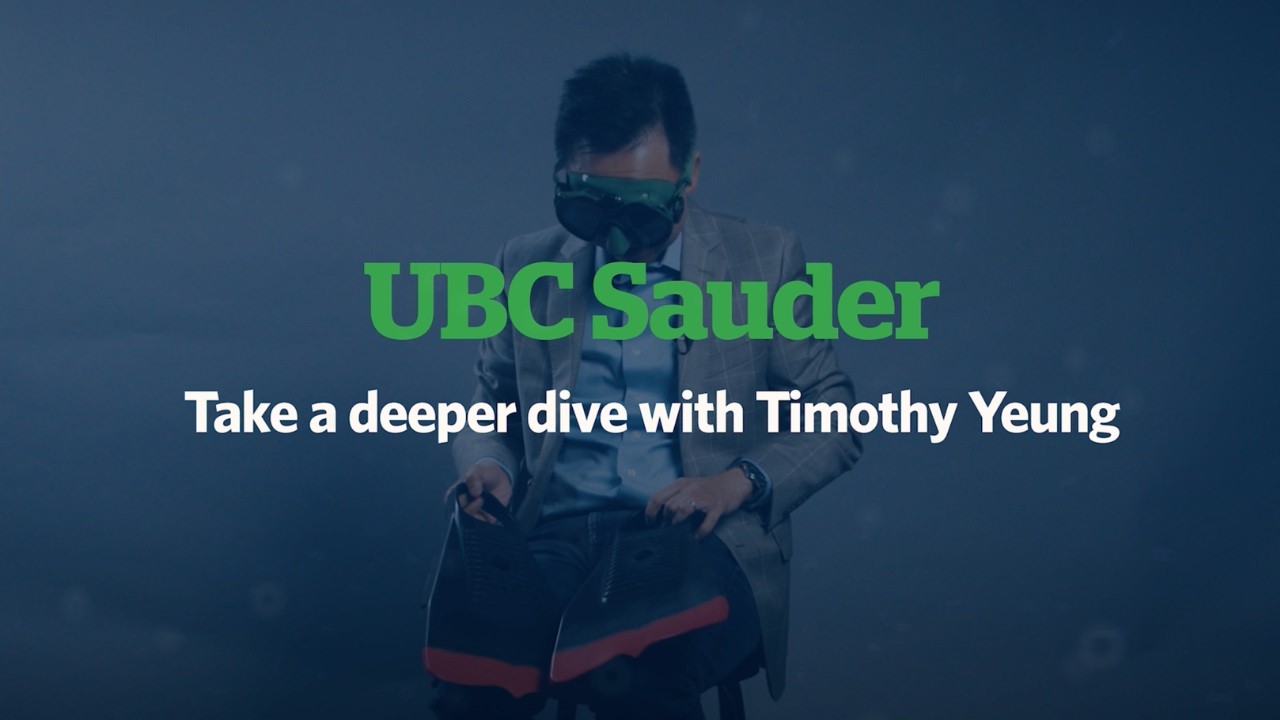
Watch: Timothy Yeung answers common questions about AI and what it means for the future of work.
1. Judgement in ambiguous, high-stakes situations
AI can process vast amounts of information and generate recommendations, but Yeung points out that it cannot decide what is wise. That distinction matters most when the decisions are messy.
"The hardest decisions are rarely the clean, obvious ones," Yeung notes. "They are the ones where the data is incomplete, where stakeholders disagree, where there are trade-offs between speed and quality, or between short-term performance and long-term reputation."
Yeung defines judgement as not just intelligence, but the capacity to pause, interpret context, weigh trade-offs, understand people, anticipate consequences, and take responsibility for a decision.
How to build judgement
To develop this skill, Yeung encourages simple habits: "Seek diverse perspectives. Write down assumptions before making a recommendation. Reflect on decisions after the fact. And ask yourself, 'What would need to be true for this to be the right decision?' That question forces you beyond the surface-level answer and into the logic underneath your thinking."
While AI can support our judgement, Yeung emphasizes that it cannot replace it, and the responsibility still belongs to humans.
2. Emotional intelligence, the foundation of human connection
While AI can simulate some specific facets of emotional intelligence, such as empathy, it cannot build trust over time, read a room, or feel the emotional weight of a difficult conversation. And in professional contexts, that gap is consequential.
"Whether you are leading a team, supporting a customer, or influencing an executive, the work is not only about exchanging information,” says Yeung. “It is about building alignment and trust."
This becomes especially important as AI continues reshaping the nature of work itself. "The most effective professionals will be those who can help people move through change with empathy and clarity," Yeung observes.
How to build emotional intelligence
While AI can simulate empathic language and some outward signs of emotional intelligence, it cannot genuinely care, form a reciprocal human relationship, read a room or feel the emotional weight of a difficult conversation.
In the current AI era, Yeung believes emotional intelligence is a strategic skill. The ability to listen deeply, sense hesitation, adapt communication, and create psychological safety will only grow in value as technical change accelerates. One practice he recommends: develop the habit of asking, "What might this person be worried about that they are not saying out loud?"
"AI may help us write the message, but humans still create the relationship. And in many organizations, relationships are what make change possible," Yeung says.
3. Purposeful creativity
AI can generate ideas at a speed and scale that are not humanly possible. But Yeung draws a clear distinction between volume and value.
"Creativity is not simply the ability to produce more options," he says. "The best creativity comes from taste, lived experience, personal conviction, and a clear sense of what matters."
Across many fields, the most valuable ideas are not just novel, they are meaningful. They solve real problems, resonate emotionally, and reflect a point of view about what should exist in the world. "AI can help generate 100 ideas, but a human still has to decide which one is worth pursuing,” he explains.
How to build creativity
He calls this purposeful creativity: not creating for the sake of creating, but creating with intention—focused on outcomes, not just outputs. His advice to professionals is to use AI as a creative partner rather than a replacement: to challenge thinking, generate alternatives, and reveal blind spots, while continuing to build their own taste, perspective, and point of view.
"One of the biggest risks of AI is that it can make everything sound polished but generic," Yeung says. "The professionals who stand out will be the ones who can bring specificity, originality, and humanity into the work."

The road ahead
AI will keep getting better, helping professionals work faster, learn faster, and build faster. But Yeung is careful to name what speed cannot replace.
"Output is not the same as outcome," he says. "Speed is not the same as wisdom."
In his view, AI fluency will become increasingly essential, but it will not be the sole measure of who can contribute meaningfully to the future. Equally important will be using AI thoughtfully, responsibly, and creatively, while deepening the human capabilities that make life and work meaningful in the first place.
"The goal is not to compete with AI at what AI does best," Yeung reflects. "The goal is to become more deeply human in the areas where humans matter most: judgement, connection, creativity, ethics, and the ability to create positive outcomes for other people."
Timothy Yeung is Lead Product Management Instructor at UBC Sauder Professional Growth. His courses support professionals and organizations navigating strategy, innovation, and the evolving demands of modern leadership.